Case Study : GB300 and Nemotron 3.5 Super VL
Thomas Lynch Founder & CEO on October 15, 2026.
What's an Actual Computer?
Actual Computer turns your NVIDIA DGX Station(s) into a department-scale AI factory, the most effective way to get maximum usage from them across your organization. Actual is powered by our engine e, purpose-built for inference on machines you own. Token delivery is fast and smooth from a single stream to a massive swarm.
Your inference is accessible to your whole team from anywhere through api.actual.inc. This relay runs on confidential compute, keeping your requests and responses private from everybody (even Actual) while inference runs on your machine.
Our target platform, one we've optimized for, is the DGX Station. We think the DGX Station will be the local AI workhorse of the tokenfactory era. Most tech businesses could benefit from owning a DGX Station.
The model we're demonstrating on this device is NVIDIA Nemotron 3.5 Super VL. VL stands for vision-language. It's capable of all sorts of multimodal input, and it's wicked smart.
How fast is a DGX Station with Actual?
An agent swarm needs more than a fast first request. It needs the whole machine to stay responsive at its maximum as agents join in, prompts get longer, and new work arrives.
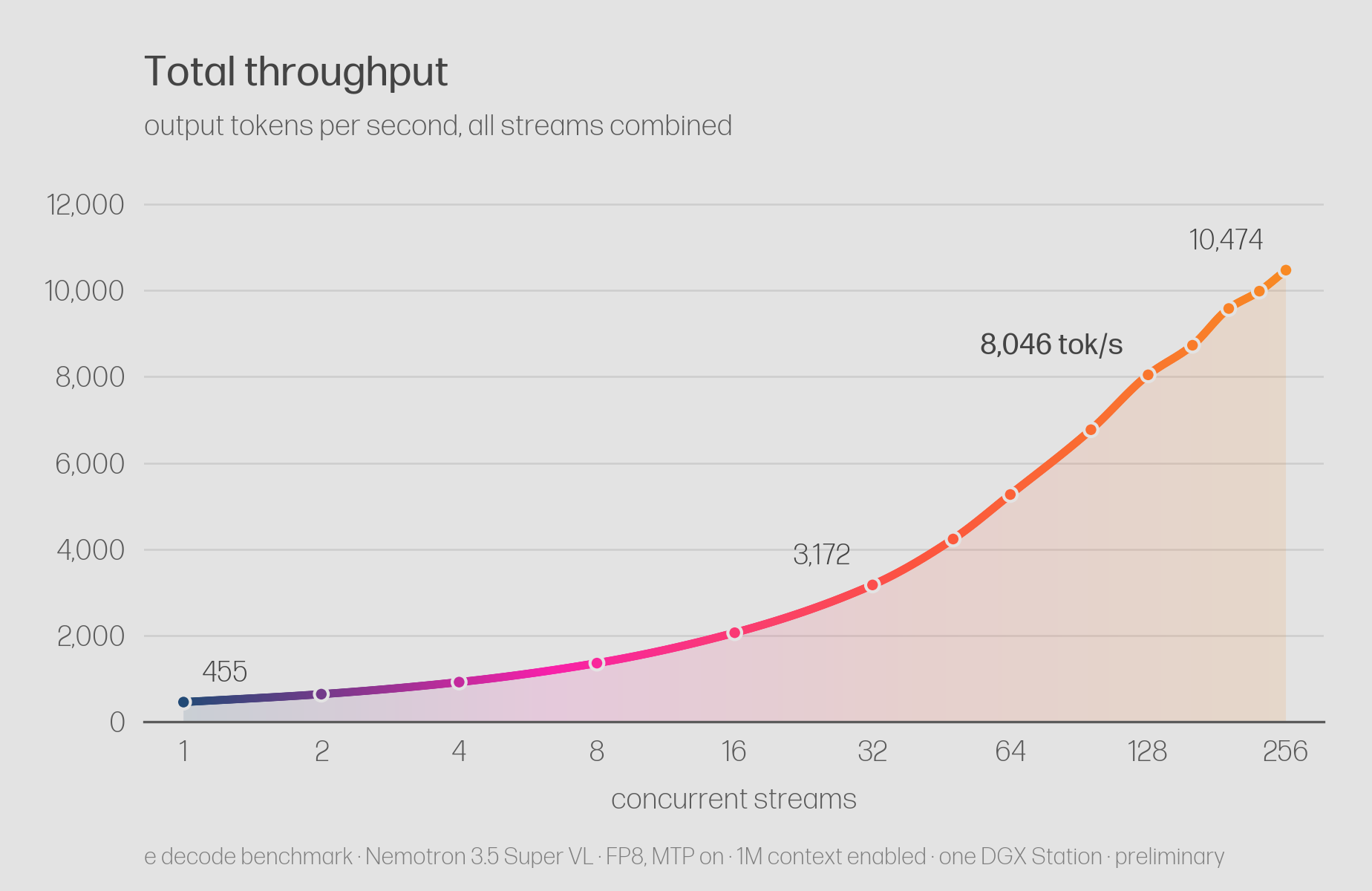
On one DGX Station, e serves Nemotron 3.5 Super VL at 455 tokens per second in a single stream. As more streams join, it climbs gracefully to north of 8,000 tokens per second across 128 streams.
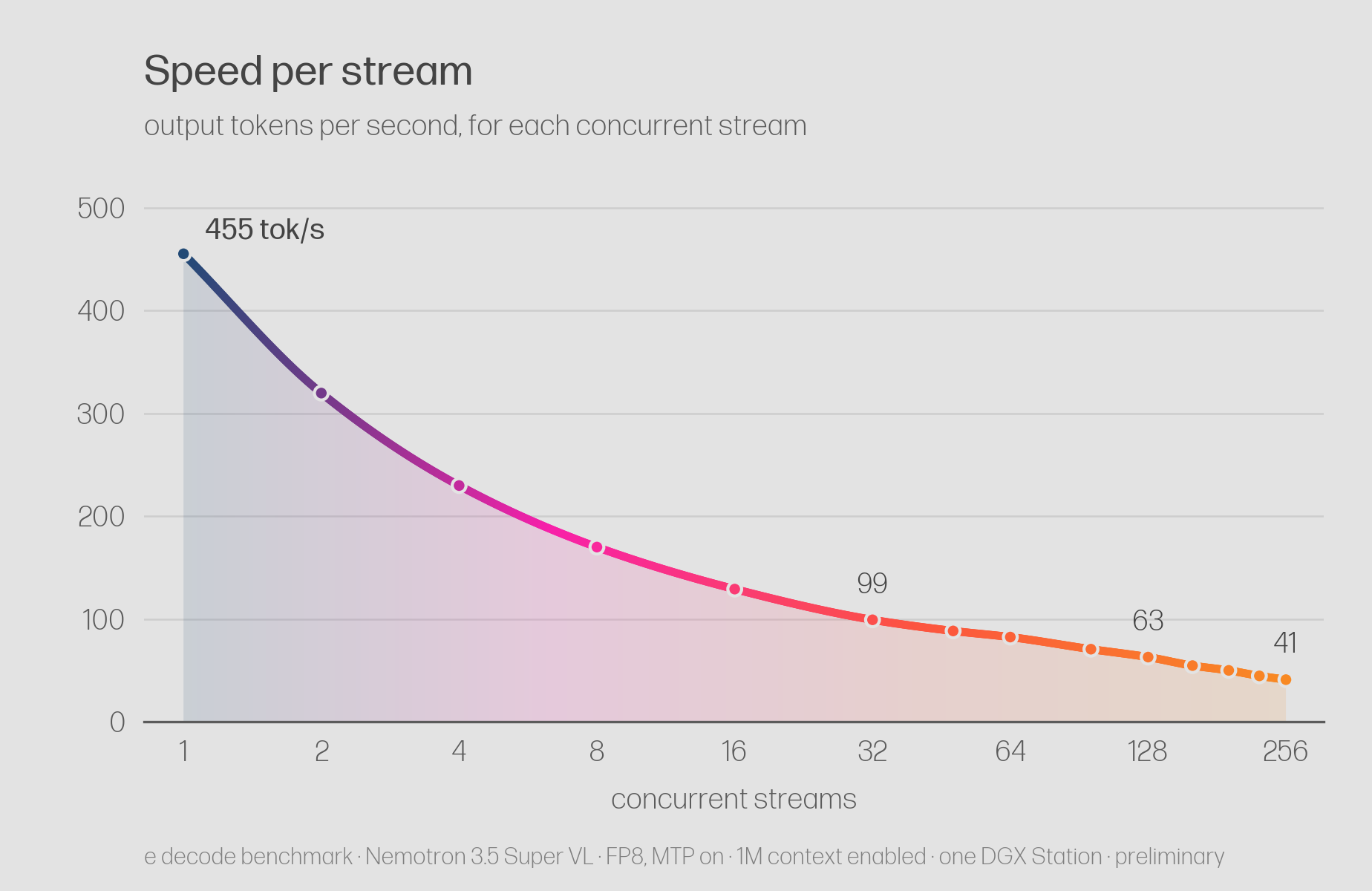
It starts fast, too: a fresh 8K-token prompt gets its first token back in 0.58 seconds.
These are preliminary decode measurements from e benchmarks on the DGX Station: FP8 weights, MTP on, 1 million context enabled. Our HTTP serving path measured within about 5% of these numbers from 1 to 128 streams.
Add it all up and one station tops 10,000 tokens per second at 256 streams.
What 8,000 Tokens per Second Is Worth
At 8,000+ tokens per second, one station produces about 691 million output tokens a day. Bought at GPT-6 Luna's list price of $0.50 per million output tokens, that's $346 a day, $10,368 a month, or about $126,000 a year, counting output tokens alone. Running flat out at its full 1.6 kW rating, the station uses about $163 a month in electricity at the US commercial average rate.
Where You Source Your Swarm
Agent swarms do the heavy lifting: 64+ subagents working in parallel. Today most teams rent that swarm from a hosted model like GPT-6 Luna and pay for every token. With Actual, the swarm runs on Nemotron on your DGX Station instead. Ours run in Hermes Agent, but any agent that speaks an OpenAI-compatible API can point at the station.
The subagents call api.actual.inc to reach the station, so you and your teammates can launch a swarm wherever you work, all on the same owned capacity.
Keep whatever conductor you like at the top. GPT-6 Astra, Claude Opus, or Kimi K3 can plan the work, hand it out, and check what comes back. Only the swarm moves to your station.
- Before: your conductor runs a swarm on hosted GPT-6 Luna.
- After: the same conductor runs the same swarm on Nemotron on your DGX Station.
What the Swarm Costs
At list prices, 32 hosted Luna subagents running around the clock (a call every 10 seconds, 25K context, 400 tokens out) cost $4,686 a month.
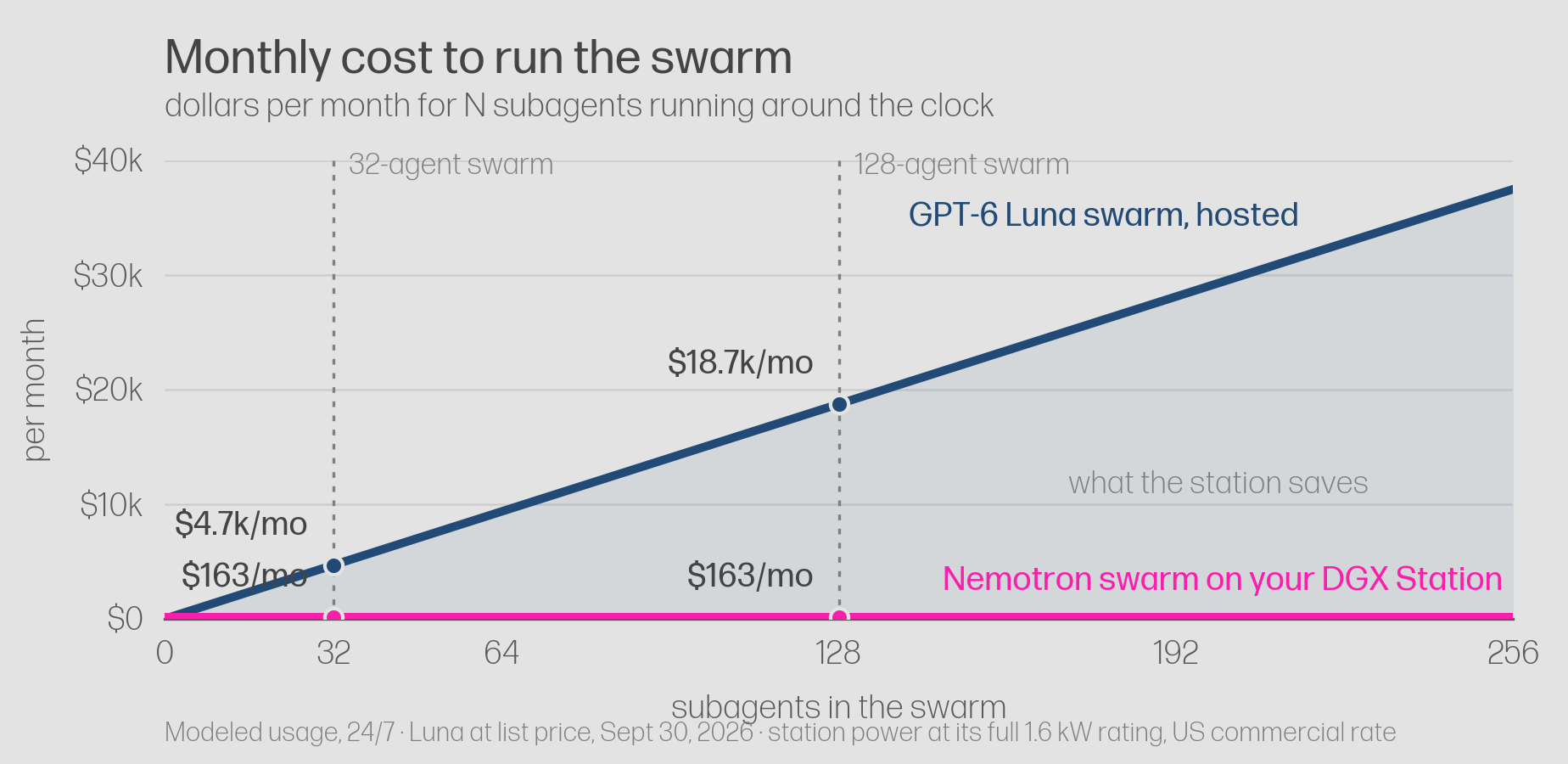
The payoff is privacy and predictable cost. Your swarm's work stays on your machine, and long-running agentic tasks stop running up a per-token bill, while you keep access to frontier models whenever you want them.
Department-Scale AI
One DGX Station can serve a whole department, with each person running their own swarm. Need more? Add stations. Your whole org still reaches all of them through the one api.actual.inc endpoint.
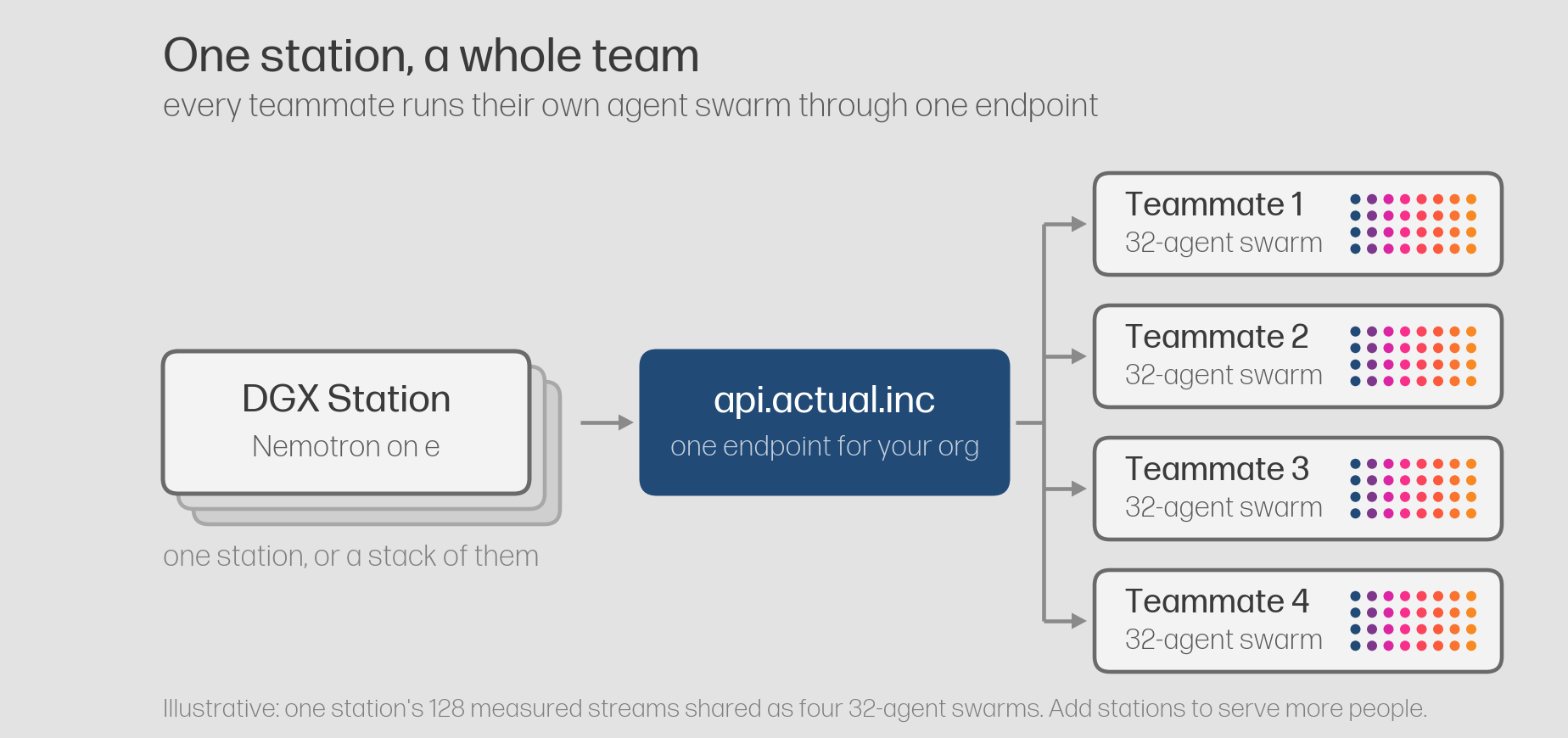
One DGX Station running Nemotron 3.5 Super VL on Actual can power an agent swarm for everyone on your team.
Install Actual
Run AI on your own computers. One command installs Actual; then authorize the device at the actual.inc/device link it prints.